Coordinates:
40.373056, 23.167595
Website:
https://petralonacave.gr/
Near the village of Petralona in northern Greece, Petralona Cave ranks among the country’s most remarkable natural landmarks. Hidden within the limestone hills of Halkidiki, it presents a subterranean landscape shaped not by sudden events, but by the patient work of water over immense spans of time. Rainwater, made slightly acidic as it passed through soil and rock, entered fractures in the limestone and gradually dissolved and enlarged them. This slow geological process created the cave’s chambers, corridors, and passages, transforming an initially narrow network into a complex underground environment.
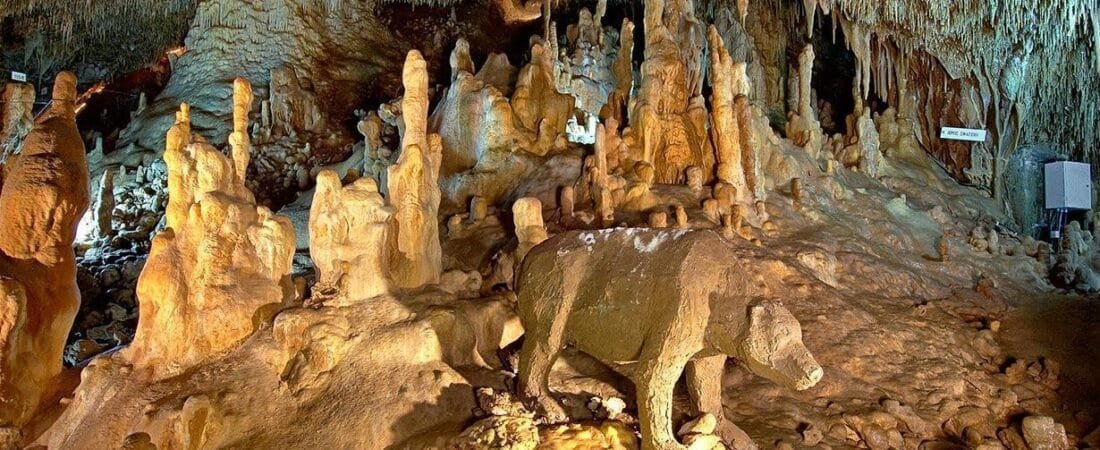
Inside, the cave reveals an extraordinary variety of mineral forms. Stalactites descend from the ceilings, while stalagmites rise from the floors, sometimes meeting to form massive columns. Elsewhere, thin curtains, flowstone surfaces, and delicate ridges spread across the walls like frozen waterfalls. These features developed as water released small quantities of calcium carbonate while moving through the cave. Layer by layer, mineral deposits accumulated, preserving the direction, intensity, and changing routes of underground water.
The scale and atmosphere of the interior make a strong impression. Broad chambers open unexpectedly beyond narrow corridors, and textured walls catch the limited light in shades of cream, ochre, and reddish brown. In other places, the passage becomes intimate and enclosed, with formations crowding the ceiling and floor. The prevailing silence, interrupted only by occasional drops of water, reinforces the sense of entering a world separated from the surface.
Petralona’s beauty is therefore more than decorative. Its formations constitute a geological record, recording variations in climate, water flow, and environmental conditions across long periods. Their shapes and layers allow researchers to study the region’s natural history and the processes that continue to influence limestone landscapes. For this reason, the cave is valued simultaneously as a natural monument and as an important scientific site. It demonstrates how gradual forces can produce an environment of exceptional visual character while preserving evidence of Earth’s changing past.
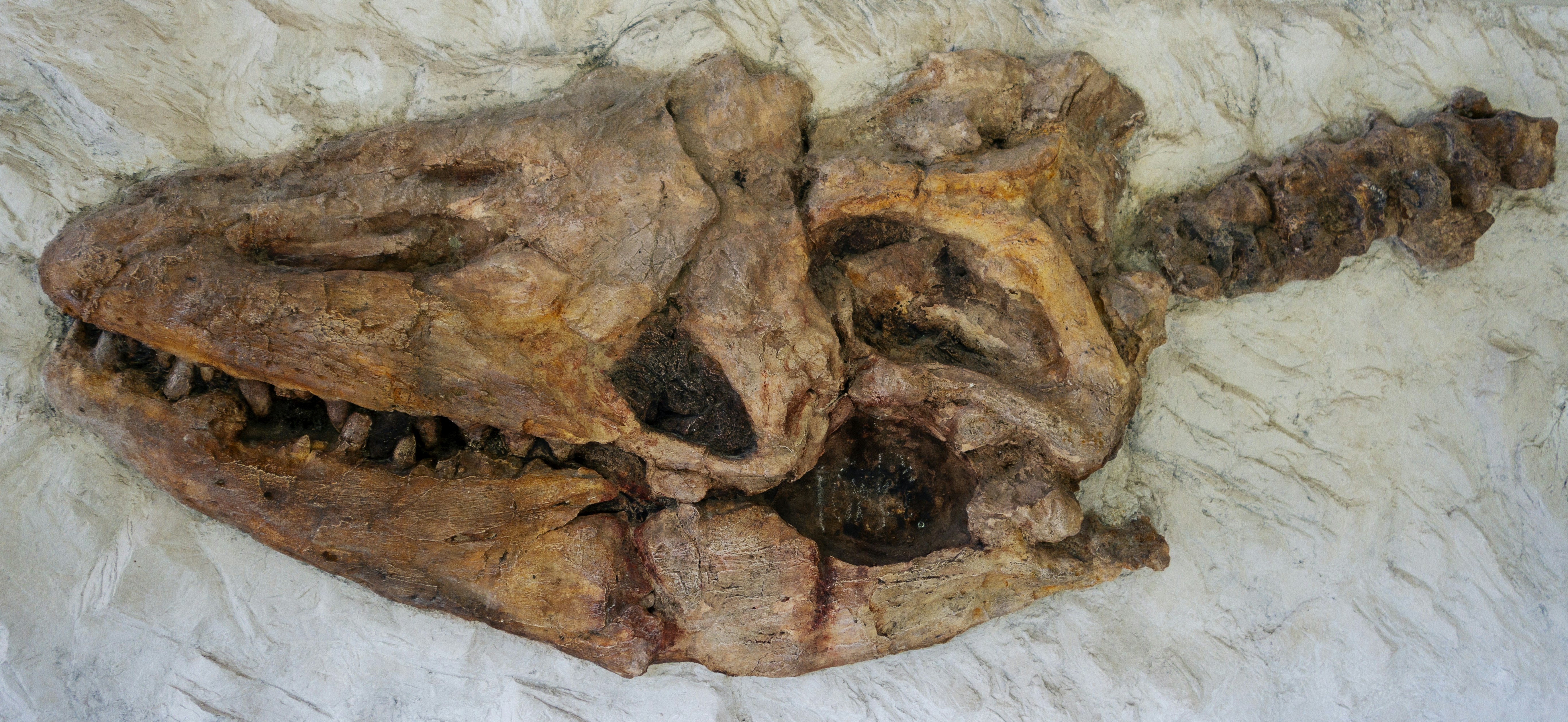
Petralona Cave was discovered in 1959, initially drawing attention for its striking geological formations. Stalactites, stalagmites, mineral deposits, and sculpted chambers created an impressive natural setting that appealed to visitors and geologists alike. At first, the cave was valued primarily as a scenic underground environment and as a record of long-term geological processes. Its significance changed fundamentally when researchers identified a human fossil within the cave. That discovery transformed Petralona from a notable natural attraction into one of Greece’s most important paleoanthropological sites.
The fossil is generally regarded as the oldest human fossil discovered in Greece to date, although its precise age and classification have remained subjects of scientific discussion. Researchers have proposed different interpretations of its anatomical features and evolutionary position, reflecting the difficulty of assigning isolated fossils to clearly defined species. Rather than representing a simple, undisputed category, the specimen is often discussed as evidence of an early transitional stage between Homo erectus and archaic Homo sapiens. Its distinctive combination of traits offers valuable material for examining how human anatomy changed over time.
The importance of the find extends beyond the identity of one individual. A human fossil provides physical evidence with which researchers can investigate early human presence, biological variation, migration, and adaptation across the European continent. It also helps place the history of European populations within a wider pattern of human evolution. Interpretation depends not only on the fossil itself but also on the geological layers and associated remains in which it was found. Sediments, animal fossils, mineral deposits, and evidence of environmental change can help establish the cave’s chronology and reconstruct the conditions surrounding human occupation. Petralona’s discovery therefore remains significant both for what the fossil reveals about anatomy and for the broader questions it raises about how early human populations reached and adapted to Europe.
Petralona Cave preserves a long and complex history of use by humans, carnivorous animals, and other organisms. Its enclosed chambers could provide protection from severe weather, cold seasons, and strong winds, while the surrounding landscape offered access to water, vegetation, and game. At the same time, a cave was not automatically a permanent settlement. Early people may have entered briefly for shelter, food processing, tool production, or rest, while predators used the same protected spaces for dens or feeding. Over thousands of years, these activities could overlap, creating a layered record rather than a single, clearly defined occupation.
The materials accumulated within Petralona Cave reflect both living activity and natural processes. Bones may have been carried in by predators, brought by humans, or washed into the cave by water. Sediment entering through openings could bury these remains, while rock falls and mineral deposits gradually altered the cave’s internal landscape. Stone tools, cut-marked bones, hearth residues, and other traces can provide direct evidence of human behavior, but their interpretation depends on context. Researchers examine the geological layer containing each object, its position, surface damage, association with other finds, and relationship to animal remains. Tooth marks, fractures, burning, and signs of deliberate butchery may help distinguish carnivore activity from human processing, although some evidence remains difficult to interpret.
These combined traces allow scientists to reconstruct aspects of the environment surrounding the cave. The species represented among the bones can indicate available habitats, climate conditions, food webs, and the presence of large predators. Their abundance and distribution may also reveal ecological pressures faced by early humans, including competition for prey, seasonal scarcity, and the risks of occupying a predator’s refuge. Sediments and mineral formations add information about changing moisture levels, landscape stability, and the cave’s physical development. Petralona therefore functions as a record of interaction among geology, wildlife, and human communities across deep time. Rather than being significant only because of one fossil, it offers a broader archive in which changing environments and patterns of occupation can be studied together.
The Petralona Museum plays an important role in preserving, organizing, and interpreting the discoveries associated with Petralona Cave. Although the cave itself remains the essential geological setting, the museum provides a protected environment where visitors can examine selected fossils, archaeological material, replicas, and supporting displays. These exhibits help communicate the significance of objects that may be too fragile, valuable, or difficult to present within the underground chambers. Educational information further explains how researchers identify, date, and interpret evidence recovered from the site.
The museum also places the famous human fossil within a wider scientific narrative. Rather than presenting the discovery as an isolated curiosity, its displays connect it with prehistoric animals, changing climates, geological processes, and the development of human beings in Europe. Information about the cave’s formations and the ancient occupation of the surrounding region demonstrates how several fields of research contribute to understanding Petralona. Geology, palaeontology, archaeology, and human evolution therefore become parts of one connected story.
Visiting the cave and museum together offers two complementary experiences. Inside the cave, visitors encounter the original setting: mineral formations shaped over immense periods, enclosed spaces, and geological features that helped preserve traces of the distant past. At the museum, those impressions are expanded through interpretation, reconstructed materials, and carefully protected evidence. The combination allows the natural landscape and the scientific record to be understood together, while reducing the need to expose delicate discoveries to unnecessary damage.
Petralona Cave consequently holds a dual significance. It is a place of remarkable natural beauty, but it is also a major source of evidence for investigating humanity’s deep past in Europe. Its continuing value depends on careful research, responsible presentation, and long-term conservation. Visitors should follow designated routes, avoid touching formations or displays, and respect all site regulations. Such consideration helps preserve the cave’s geological character and archaeological heritage, ensuring that future generations can continue to study and appreciate this exceptional record of prehistoric life and human history.